On another note, we were talking about cultural competency and global health this morning in the orientation - most of which was kind of boring. But I did find this interesting (and this is all according to the local CFHI coordinator here):
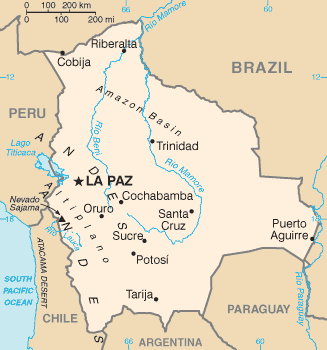
The Aymara have a different way of looking at time than the Western world. When they refer to the past, they point in front of them; and when they want to indicate the future, they point behind them. They say that the past is kept in front of you while the future is behind you because you can see the past, but you can't know the future.Furthermore, this reversal of the Western concept of time can be detrimental to Aymara health because it facilitates an "everyone dies sometime" attitude, which can lead to postponement of treatment.
I don't know how true or untrue the last statement is, but I think a similar situation arises in "uneducated" populations in developed countries - even without the "time reversal" thing. But regardless of the actual effects on health care, I still like the philosophy. It relates nicely to the book I was reading last night (yeah, so I finished A Ticket to the Boneyard) - the detective is reading Marcus Aurelius' Meditations and he reads the part that says "Whatever happens at all happens as it should; you will find this true, if you watch narrowly." He obsesseses about it a bit, but it's understandable. If everything is as it should be, why try? But next to the Aymara insight into past and future, I think there is a better meaning. I think there is peace to be found in knowing the past and letting go of the future - not so that you fail to take care of yourself and your family, but just to put everything into perspective. 'Cause, you know, we're all going to die someday.
Then again, I also think that it's hard to draw the correlative line between philosophy and life practice. Philosophizing thoughts are intangible (or at least not quantifiable) and highly personal, so I have a hard time sticking with the idea that one philosophy is valid for all people. Ack. I think I'm ready for bed now.

1 comments:
Wow! I love it!!! There's this one physicist/philosopher that thinks the idea that humans naturally place a large amount of concern on the future because that would create a stronger species. For instance, even if a person had a great life in his past, he would still be very anxious about future pains. Such a person with a large amount of suffering in the future, even if his past is rather nice and cheerful, is often considered to be "doomed". It is this bias towards the future that this physicist/philosopher thinks encourages people to live longer lives because they plan better for future fortuities.
Even if this theory were true (which I'm not so sure about) the Aymara show that regarding the future as more important than the past is not a view inherent in the human body. It would be interesting to see how their perception of time affects daily routines and life patterns...
Post a Comment